Do Indian Businesses Still Need a Website in 2026 or Is Instagram Enough?
Instagram is not enough for Indian businesses in 2026. Discover the 5 commercial gaps Instagram can't fill and why a website still wins.
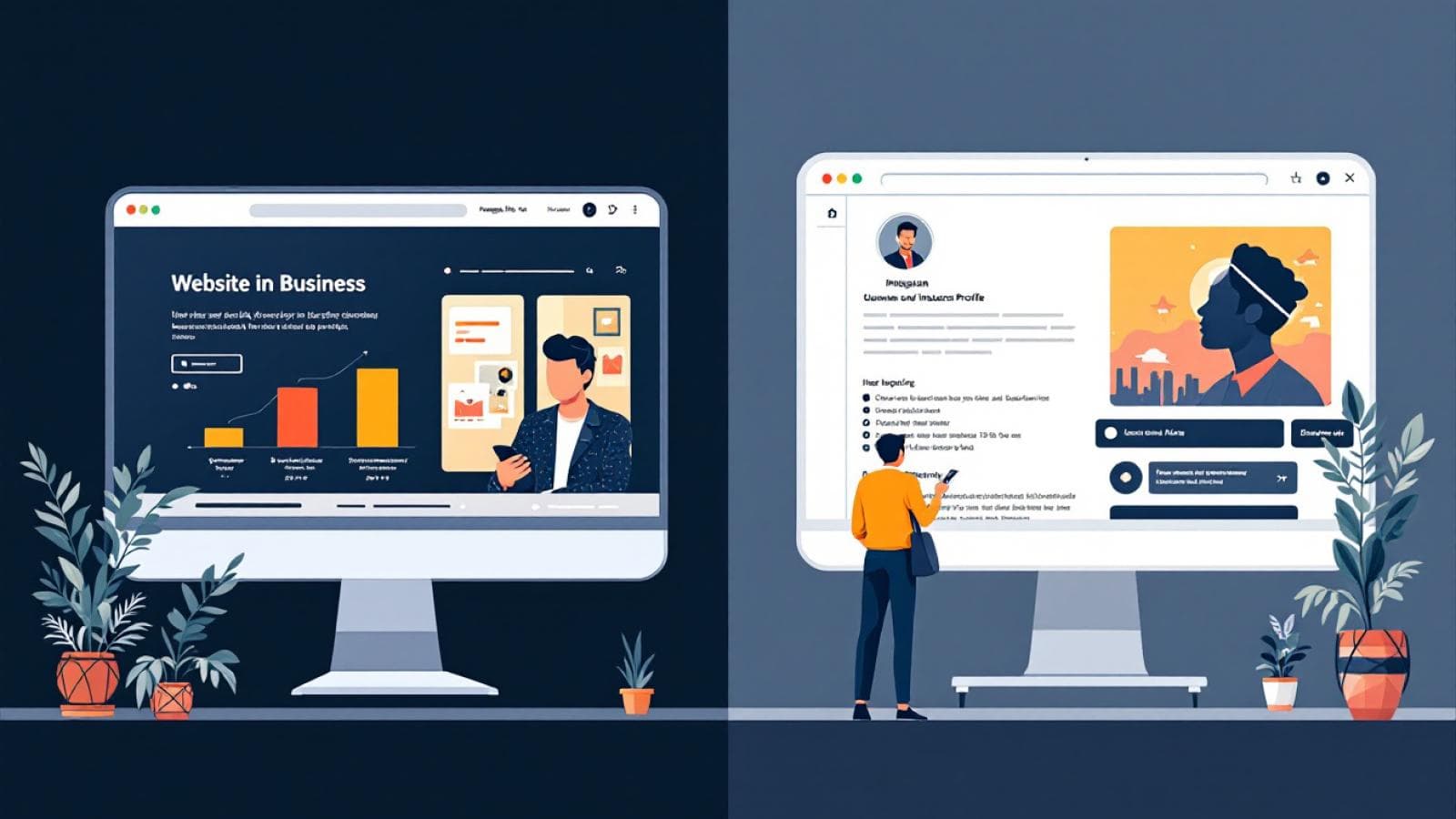
Indian businesses in 2026 face a question that comes up in every WhatsApp group, every networking event, and every conversation about digital marketing: do I still need a website if I'm already active on Instagram? The short answer is yes — and by the end of this article, you'll understand exactly why, with data to back it up.
This is not a theoretical debate. It's a revenue decision. The businesses choosing Instagram-only are losing leads every day to competitors who show up on Google. Let's break down where the gaps are — and what the minimum investment looks like for an Indian business in 2026.
The Real Question: Where Do Your Buyers Search Before They Call You?
Before a Mumbai buyer calls any business, they Google it. That is the behaviour pattern that defines the Indian B2C and B2B purchase journey in 2026 — regardless of how the buyer first discovered the business.
Google's own data shows that 68% of all online experiences begin with a search engine. In India, that number holds firm even as Instagram and YouTube grow. A buyer might see your Instagram reel, feel interested, and then immediately open Google and type your business name — or your service plus their city. What they find (or don't find) at that moment determines whether they call you or your competitor.
Instagram does not appear in those Google results. Your business website does.
The search journey for a typical Mumbai buyer buying a service looks like this:
- Sees a referral, WhatsApp forward, or Instagram post about a business or service
- Googles the business name or service + locality (e.g. "interior designer Bandra" or "CA firm Andheri")
- Checks the top 3 results — looks for a website, reviews, and a contact number
- If no website is found, trust drops immediately — many buyers move to the next result
- Sends a WhatsApp enquiry or calls the number on the website
Instagram only influences Step 1. Your website wins or loses the deal at Steps 3 and 4.
What Instagram Cannot Do That a Website Can: The 5 Commercial Gaps
Instagram is an excellent awareness and brand-building tool — but it has five commercial gaps that make it unsuitable as your only digital presence.
Gap 1: Instagram Does Not Appear in Google Search Results
Instagram profiles rank very weakly in Google. A buyer searching "web designer Mumbai" or "accountant Thane" will not find your Instagram profile on Page 1. They will find websites. Without a website, you are invisible at the exact moment a buyer is ready to hire.
Gap 2: Instagram Cannot Capture Leads Without Paid Tools
A website with a contact form or a WhatsApp link captures leads 24/7 — no manual effort needed. Instagram requires a buyer to remember to DM you, find your link in bio, or tap the Story link before it disappears after 24 hours. Lead capture on Instagram leaks constantly; a well-built lead generation website captures every interested visitor.
Gap 3: Instagram Does Not Build Credibility the Same Way
A Google survey of Indian SMB buyers found that 84% of buyers feel more confident contacting a business that has a professional website compared to one with only a social media profile. A website signals permanence. Instagram signals presence — but presence alone doesn't close deals at higher ticket sizes.
Gap 4: Instagram's Algorithm Controls Your Reach
Organic Instagram reach dropped from 16% in 2019 to under 4% in 2024 for business accounts, according to Hootsuite's global social media report. Your followers don't see your posts unless Instagram's algorithm decides to show them. A website visitor arrives because they chose to — their intent is far higher.
Gap 5: You Don't Own Your Instagram Audience
Instagram can ban, restrict, or shadowban your account at any time. Thousands of Indian business owners lost years of content and their entire follower base to account bans in 2023–2024 alone. Your website — your domain, your content, your customer data — belongs to you. No algorithm can take it away.
Ready to stop relying on Instagram alone? Get a professional business website built for lead generation — not just likes.
See Our Web Development PackagesHow Google Uses Your Website to Rank You — and Why Instagram Profiles Don't Qualify
Google ranks websites, not Instagram profiles, in its organic search results — and the difference in traffic quality is enormous.
Google's ranking system works by crawling and indexing web pages, analysing the content on those pages for relevance to a search query, and serving the most relevant, authoritative results. For a business to rank for terms like "does my business need a website India 2026", "web designer Andheri", or "best interior designer Mumbai", that business needs indexable web pages with relevant content, internal links, and technical SEO signals.
Instagram pages are partially indexed by Google but rank weakly because:
- Instagram blocks most of its content behind login walls
- Instagram profiles have almost no unique text content Google can parse for service relevance
- Instagram links use nofollow attributes, meaning they pass zero PageRank authority
- Instagram URLs contain no location or service signals that help local SEO
A website, by contrast, gives Google exactly what it needs: dedicated service pages, location-specific content, schema markup, and inbound links. A well-structured local SEO strategy built on your website can get you to Page 1 for local service searches within 3–6 months — a result Instagram can never deliver.
Google's local ranking algorithm (the "Local Pack" that shows the map + 3 businesses) weighs three factors: relevance, distance, and prominence. Your website contributes directly to prominence — it provides Google with service descriptions, reviews, backlinks, and content authority that your Instagram profile cannot.
The Mumbai Case: Local Buyers Trust Businesses With Websites 3x More
Mumbai buyers are sophisticated. They compare options, check credentials, and Google extensively before spending money — especially at ticket sizes above ₹5,000.
Research from BrightLocal's India consumer survey shows that local buyers trust businesses with websites 3x more than businesses with only a social media presence. In Mumbai's competitive market, where dozens of service providers exist in every category, that trust gap directly translates to revenue.
The Mumbai-specific buyer behaviour pattern is distinctly WhatsApp-first for communication but Google-first for discovery. A buyer in Andheri looking for a CA firm will:
- Google "CA firm Andheri West" or "tax consultant near me"
- Click the first result that has a website and reviews
- Check the website for legitimacy (address, team, client list)
- Then contact via WhatsApp — the number they found on the website
Notice what's missing from that journey: Instagram. Instagram plays no role in this buyer's decision. A business without a website is simply not part of the consideration set.
The same pattern holds across Mumbai's professional services market — interior designers in Bandra, architects in Powai, security services in Thane, consultants in BKC. In every category, the businesses generating consistent inbound enquiries are the ones with websites — not just Instagram accounts.
For higher-ticket B2B purchases (above ₹1 lakh), the trust gap widens further. A vendor without a website is often disqualified before the first meeting. Procurement teams and senior managers expect a URL — not an Instagram handle — when vetting a supplier.
The Minimum Viable Website for an Indian Business: What You Actually Need in 2026
You don't need a 20-page website with a blog, e-commerce, and a client portal to start generating leads in India in 2026. The minimum viable business website for most Indian SMBs has five elements.
Element 1: A Clear Services Summary
One section — or one dedicated page — that explains exactly what you do, who you serve, and what outcome you deliver. Use plain language. "Interior design for 2BHK and 3BHK homes in Mumbai — full project, turnkey delivery" is better than a paragraph of jargon.
Element 2: Social Proof (Testimonials or Client List)
Three genuine testimonials from real clients, ideally with names and locations ("Rajesh Mehta, Restaurant Owner, Borivali"), do more for conversion than any amount of copy. If you've served 10+ clients, list their company names or sectors instead.
Element 3: Mobile-Optimised Design
Over 87% of Indian internet users browse on mobile, according to Statcounter's 2025 India data. If your website breaks, overflows, or loads slowly on a ₹12,000 Android phone, you will lose more leads than you capture. Mobile optimisation is not optional in India in 2026 — it is the baseline.
Element 4: WhatsApp Integration + Phone Number
Indian buyers prefer WhatsApp for first contact. A visible WhatsApp chat button, a click-to-call phone number, and a simple contact form are the three conversion elements every Indian business website must have. Remove friction — don't make buyers hunt for your contact details.
Element 5: Basic On-Page SEO
Your homepage title tag should name your service and city. "Interior Designer in Mumbai | [Your Business Name]" will get you indexed for local searches within days of launch. Add your Google Business Profile, link your website to it, and you've activated the local ranking engine.
Total investment for this minimum viable website: ₹8,000–₹20,000 for a one-page or three-page professional site. The leads from a single month of Google traffic will typically recover that cost.
Website vs Instagram: Head-to-Head Comparison
| Factor | Website | |
|---|---|---|
| Ownership | You own it fully — domain, content, data | Platform owns it — can ban or restrict anytime |
| Google Ranking | Ranks directly for local and service keywords | Ranks weakly; mostly blocked behind login |
| Credibility | Trusted 3x more by Indian buyers (BrightLocal) | Seen as supplementary; not a trust anchor |
| Lead Capture | Forms, WhatsApp links, call buttons — 24/7 | DMs and link-in-bio only; leaky funnel |
| Google Maps Ranking | Directly boosts GBP prominence signal | No impact on Google Maps ranking |
| Cost to Start | ₹8,000–₹35,000 one-time build | Free to post; paid ads from ₹500/day |
| Algorithm Dependence | Low — SEO traffic compounds over time | High — reach drops without consistent posting |
| Best Use | Decision stage: capturing and converting leads | Awareness stage: brand visibility and reach |
The table makes the answer clear: Instagram and a website are not competitors — they are partners. Instagram fills the top of the funnel. Your website closes the deal.
Most Mumbai businesses are losing 60–70% of their potential leads because they have no website to send buyers to. Let's fix that.
Get Your Business Website Built TodayFrequently Asked Questions
Can I use a one-page website instead of a full website for my Indian business?
Yes, a one-page website is a strong starting point for most Indian small businesses. A single page covering your services, testimonials, a WhatsApp contact button, and a clear phone number gives Google enough content to index you and gives buyers enough trust to call. It costs far less than a multi-page site — typically ₹8,000–₹20,000 — and can be live within a week. Upgrade to multiple pages once you start generating leads consistently.
How much does a basic business website cost in India in 2026?
A basic business website in India in 2026 costs between ₹8,000 and ₹35,000 depending on the number of pages, design complexity, and whether you need a contact form or WhatsApp integration. A one-page site with mobile optimisation and basic SEO setup starts at around ₹8,000–₹12,000. A five-page professional website with lead capture and Google Analytics runs ₹20,000–₹35,000. Custom ecommerce builds start at ₹50,000 and above.
Will a website help my business rank on Google Maps?
Yes, having a website significantly improves your Google Maps (Google Business Profile) ranking. Google's own documentation confirms that businesses with a linked website rank higher in local search results because the website provides additional signals about your services, location, and authority. Businesses without a website are routinely outranked by competitors who have one, even when those competitors have fewer reviews.
Is it worth having both a website and Instagram for a small Indian business?
Absolutely — and the two channels serve completely different jobs. Instagram builds awareness and brand personality; your website captures and converts that awareness into leads. The ideal flow for an Indian small business is: Instagram post sparks interest → buyer Googles your business name → your website provides trust signals (testimonials, services, phone number, WhatsApp link) → buyer calls or messages you. Removing either channel weakens the chain.
What happens to my business if Instagram shuts down or bans my account?
If Instagram shuts down or bans your account, you lose all your followers, posts, and contact history overnight — with no warning and no recourse. This has already happened to thousands of Indian business owners whose accounts were flagged for policy violations or caught in platform-wide outages. A website is the only digital asset you fully own. Your domain, your content, and your customer enquiries cannot be taken away by a platform's algorithm or policy change.