Website Design for Architecture Firms in Mumbai: What Clients Actually Look For
What Mumbai architecture clients actually check before enquiring: portfolios, credentials, mobile speed, and easy contact paths.
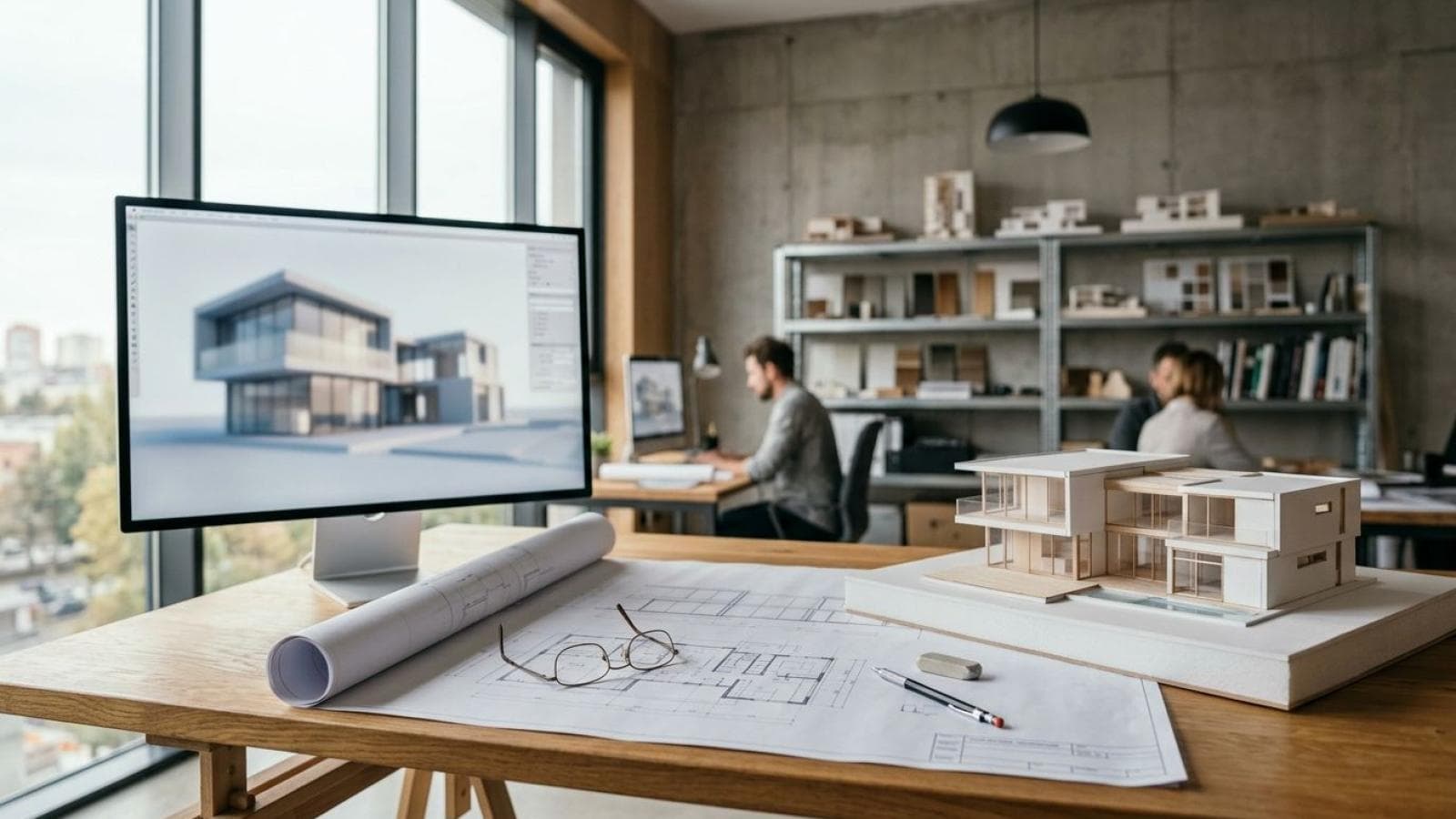
Architecture firms lose projects before a phone ever rings. A prospective client shortlists three or four firms online, opens each website on their phone, and rules out the ones that don't show real project photos or make it obvious how to get in touch. If your site loads slowly, buries your portfolio behind a PDF download, or has no clear way to book a consultation, you're out of the shortlist in under 20 seconds.
This guide covers exactly what clients look for on an architecture firm website — project galleries, credibility signals, mobile performance, and enquiry paths — based on what actually converts visitors into consultation bookings for design and architecture practices in Mumbai.
What Clients Actually Check First on an Architect's Website
A potential client visiting an architect website in Mumbai checks three things within the first ten seconds: does this firm have real, recent project work; does the site look professionally built; and can I contact them without hunting for a phone number. Google's Core Web Vitals report (updated 2024) shows that 53% of mobile visitors abandon a page that takes longer than 3 seconds to load — for a portfolio-heavy site with large images, that's the single biggest silent deal-breaker most architecture firms never diagnose.
Search demand backs this up directly. The keyword "website for architects" gets roughly 1,900 searches a month in India with low competition — one of the largest niche-vertical search terms we've found across any professional-services category, meaning a large number of architecture practices are actively searching for exactly this kind of website upgrade, not just browsing template marketplaces.
This pattern isn't unique to architecture. We've seen the same buying behaviour play out for interior design firms in Mumbai — clients in visual, project-based professions make almost the same three checks before they pick up the phone. Architecture firms just have more at stake per project, which makes getting the website right even more important.
Project Portfolio Presentation: Your Single Most Important Page
Your portfolio page is the page that decides whether a visitor contacts you. Clients want to see the kind of work you've completed that resembles their own project — a residential bungalow, a corporate office fit-out, a retail interior — organised so they can find it in two clicks, not scroll through fifty unsorted thumbnails.
Organise by project type, not by date
Group projects into clear categories: residential, commercial, interior, renovation, institutional. A client searching for "architect for a 3BHK renovation in Andheri" needs to see renovation work immediately, not your 2019 chronological archive. Each category should load its own filtered view with a maximum 2-second render time on mobile.
A category filter also does something subtle but valuable for search visibility: it creates a dedicated URL for each project type, which means your "residential architecture Mumbai" work can rank on its own, separate from "commercial fit-out Mumbai." Most architecture firm sites we review still dump every project onto a single unfiltered page, which flattens all of that potential ranking value into one generic portfolio URL competing for every keyword at once.
Each project card should also carry a one-line project brief — location, built-up area, and project type — directly under the thumbnail. Clients scanning quickly rarely click into a project without that context first; the brief line is what decides whether the click happens at all.
High-resolution images that still load fast
Architecture sells on visual quality, but an unoptimised 8MB image kills your mobile load speed. Serve responsive, compressed images (WebP format, lazy-loaded below the fold) so a gallery of 40 project photos still loads the first screen in under 2 seconds. Google's Web Vitals data confirms mobile pages that hit this benchmark see meaningfully lower bounce rates than slower competitors in the same search results.
Before/after comparisons and 3D render galleries
Clients evaluating a renovation or interior project want to see the transformation, not just the finished shot. A simple before/after slider format — original site photo next to the completed build — builds more trust than a polished render alone, because it proves the work actually happened. For new-build projects, pairing a 3D render with the completed photograph in the same gallery card shows prospective clients that what you promise on-screen is what gets delivered on-site.
Video walkthroughs add a further layer of proof for larger commercial or institutional projects, where a client is often deciding on behalf of a board or committee and needs material they can forward internally. A 30-45 second vertical video clip embedded directly in the project card — no separate download required — gets shared far more often than a static gallery, because it's frictionless to pass along in a WhatsApp thread.
Need a portfolio-first website that showcases your architecture projects properly, with fast load times built in from day one?
See our business website buildsCredibility Signals That Actually Close Deals
Credibility signals answer the question every architecture client asks silently: "can I trust this firm with a project worth lakhs of rupees?" A missing "About" page or an empty credentials section is one of the fastest ways to lose a serious enquiry to a competitor who shows theirs clearly.
Licenses, registration, and professional memberships
Display your Council of Architecture (COA) registration number and any Indian Institute of Architects (IIA) membership prominently — ideally on the homepage footer and the About page, not buried in a downloadable brochure. For commercial and institutional clients specifically, this single detail often decides whether your firm makes it past the first screening call.
Press mentions and awards
If your firm has been featured in a design publication, won a regional award, or been quoted by a local business journal, that mention belongs on your homepage, not a hidden "News" tab nobody clicks. A single verifiable press logo does more to build trust in five seconds than three paragraphs of self-description.
Client testimonials tied to specific projects
Generic five-star quotes ("Great team, highly recommend!") carry almost no weight anymore. Testimonials that name the project type and location — "redesigned our 2,400 sq ft office in Lower Parel on time and on budget" — read as verifiable and specific, which is exactly what a skeptical client is scanning for.
Team bios and a clear project process
Architecture is a relationship-heavy service, and clients want to know who they'll actually be working with before the first meeting. A short bio for the lead architect and key team members, alongside a simple 4-5 step outline of your process — consultation, design concept, approvals, construction drawings, site supervision — removes a lot of the uncertainty that keeps a hesitant enquiry from turning into a signed brief.
Mobile Experience Matters Most During Actual Site Visits
Architecture clients pull up your website on their phone constantly — while standing at the plot, mid-site-visit, or comparing your portfolio against a competitor's in a WhatsApp group with their spouse or business partner. A site that isn't genuinely mobile-first fails at the exact moment it matters most.
Thumb-friendly navigation and tap targets
Menu items, gallery filters, and contact buttons need to be large enough to tap accurately with one thumb — Google's mobile usability guidelines recommend a minimum 48x48 pixel tap target. Anything smaller forces a client to zoom and pinch on-site, which is precisely when they close the tab and call your competitor instead.
Click-to-call and WhatsApp buttons, not just a contact form
A contact form buried at the bottom of the page loses urgent enquiries. Architecture clients standing at a plot or in a meeting want to tap once and either call or send a WhatsApp message immediately. A floating WhatsApp button paired with a sticky "Call Now" bar on mobile captures enquiries that a static form would silently lose.
| Enquiry Method | Typical Response Speed | Best Use Case |
|---|---|---|
| WhatsApp button | Fastest — real-time chat | Site-visit questions, quick project queries |
| Click-to-call | Immediate | Urgent enquiries, budget discussions |
| Contact form | Hours to next business day | Detailed project briefs, RFQs |
| Consultation booking calendar | Scheduled slot | Serious leads ready to discuss a project in depth |
Making It Easy to Book a Consultation
A consultation booking flow removes the back-and-forth email exchange that stalls most architecture enquiries. Instead of "email us and we'll get back to you," an embedded calendar link lets a client pick a slot directly, which shortens your average lead-to-first-call time from days to minutes.
What to ask for upfront, and what to skip
Keep the enquiry form to five fields maximum: name, phone or WhatsApp number, project type, approximate budget range, and project location. Every additional field drops form completion rates — architecture clients researching multiple firms will abandon a ten-field form rather than fill it out for a firm they haven't fully decided on yet.
- Name and preferred contact method (phone or WhatsApp)
- Project type (residential, commercial, interior, renovation)
- Approximate project budget range
- Project location or plot address
- Preferred consultation date, if a calendar booking option is offered
Ready to turn your website into a lead-generating asset instead of a digital brochure?
Request a free quoteWhy Architecture Firms Are an Underserved Search Niche in Mumbai
The keyword "website for architects" shows roughly 1,900 monthly searches nationally with low ranking competition, according to keyword-volume data reviewed for this analysis — a rare combination of high demand and low competitive pressure. Most architecture firms in Mumbai still rely on Instagram and word-of-mouth referrals instead of a properly optimised website, which means the firms that do invest in local SEO and a fast, portfolio-first site have an open runway to rank for exactly the searches their next clients are already typing.
Pairing a strong portfolio site with local SEO — Google Business Profile optimisation, location-specific service pages, and consistent NAP (name, address, phone) details — compounds the advantage further, since architecture searches are almost always paired with a locality: "architect in Bandra," "architect for bungalow renovation in Thane," and similar patterns.
A location-specific service page for each area you actively serve — "Architect in Bandra," "Architect in Powai" — gives Google a targeted page to rank for each of those local searches, instead of forcing your single homepage to compete for all of them simultaneously. Firms that skip this step typically rank on page two for every locality search, even when their portfolio work is strong, simply because there's no dedicated page for Google to match the query against.
What a Conversion-Focused Architecture Website Actually Looks Like
A conversion-focused architecture website treats every page as a step toward one outcome: a booked consultation. That means the homepage leads with your strongest 3-4 projects above the fold, not a generic hero banner with stock photography; the navigation has no more than six items so a visitor never has to think about where to click; and every project page ends with the same enquiry prompt, so there's never a dead end in the browsing experience.
Speed and structure matter as much as design here. A site built on a modern framework with image optimisation baked in — rather than a heavy page-builder plugin stacked with add-ons — routinely loads 2-3x faster on mobile networks, which directly affects how many visitors stay long enough to reach your enquiry form in the first place.
Frequently Asked Questions
What should an architecture firm website include?
An architecture firm website should include a categorised project portfolio, credentials such as Council of Architecture registration, client testimonials tied to specific projects, a fast-loading image gallery, and a simple enquiry path via WhatsApp, click-to-call, or a short contact form. These elements together answer the credibility and capability questions a prospective client is evaluating before they reach out.
How much does a website for an architecture firm cost in Mumbai?
A professionally built website for an architecture firm in Mumbai typically starts around ₹35,000-₹45,000 for a portfolio-focused site with a custom gallery system, and can run higher for advanced features like 3D render integration or a booking calendar. Pricing depends on the number of project categories, image volume, and whether ongoing SEO support is included.
Why do architecture firms need a portfolio-first website design?
Architecture firms need a portfolio-first design because clients decide whether to make contact almost entirely based on visual proof of past work. A generic template that buries project photos behind slow-loading pages or a downloadable PDF loses the exact visitors who were ready to enquire, so the portfolio needs to be the fastest, most prominent part of the site.
Does a mobile-friendly website really matter for an architecture firm?
Yes — a mobile-friendly website matters significantly because architecture clients frequently browse firms' portfolios on their phones during actual site visits or while discussing options with a partner in real time. Google's own Core Web Vitals data shows a majority of mobile visitors abandon pages that load slower than 3 seconds, which directly costs architecture firms enquiries from exactly the moment a client is most engaged.
How can an architecture firm get more enquiries from its website?
An architecture firm can get more website enquiries by adding a floating WhatsApp button, a click-to-call bar on mobile, a short five-field enquiry form, and a consultation booking calendar link, while also organising the portfolio by project type so visitors can quickly find work matching their own project before deciding to reach out.