Website Design for Hotels & Guesthouses in Mumbai: Direct Bookings Over OTA Fees
OTAs take 15-25% commission per booking. See the real cost comparison and how a direct-booking website, WhatsApp flow, and GBP setup win back margin.
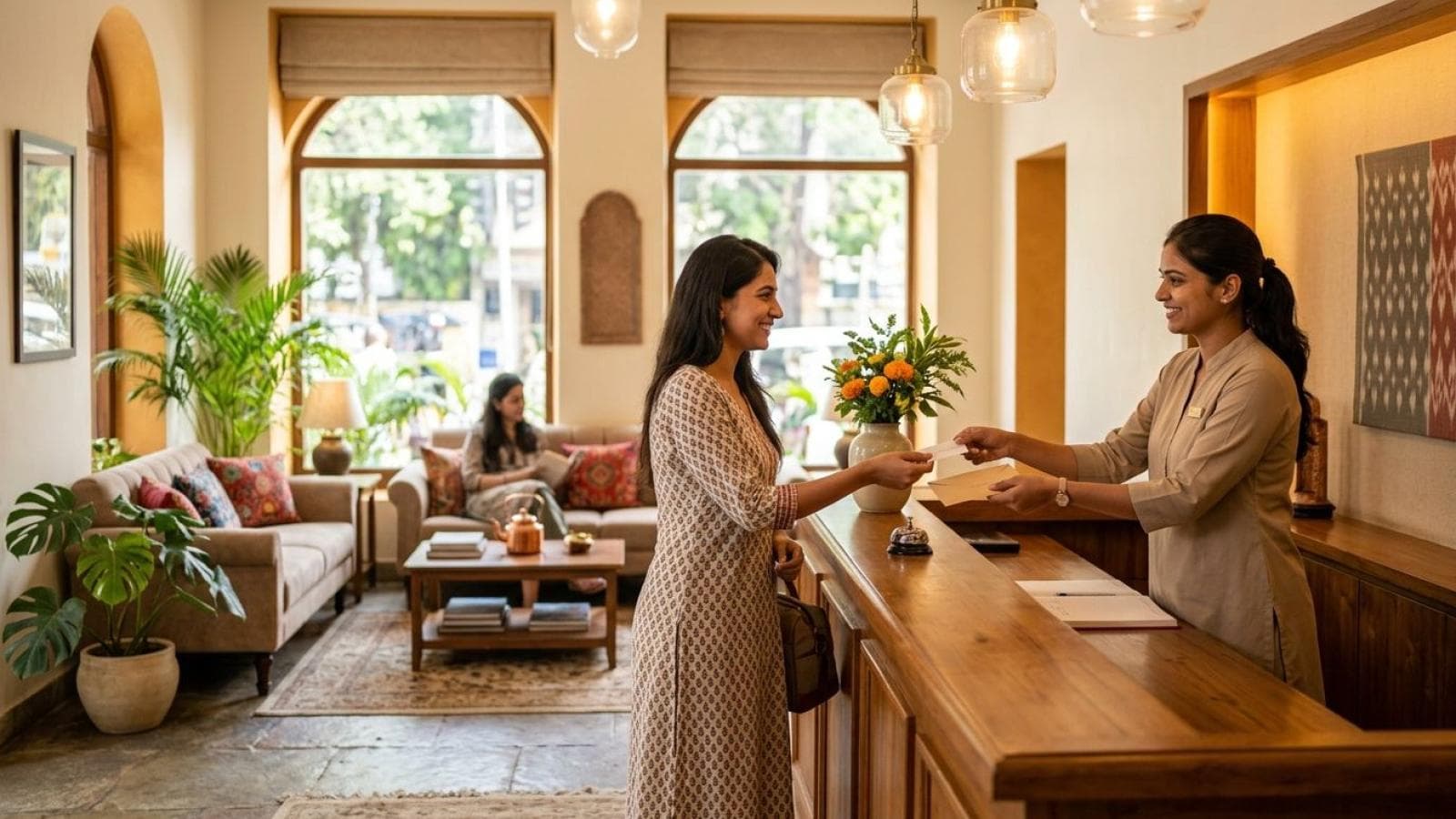
Booking.com, MakeMyTrip, and Goibibo take between 15% and 25% commission on every room you sell through them. On a ₹4,000-a-night room, that's ₹600 to ₹1,000 gone before you've paid for housekeeping, breakfast, or electricity. A boutique hotel or guesthouse in Mumbai running at 65% occupancy on OTA bookings alone can lose ₹3-6 lakh a year to commissions on a modest 15-room property — money that could fund a renovation, a marketing budget, or straight profit.
This isn't an argument to quit OTAs. Booking.com and MakeMyTrip still bring first-time guests who've never heard of your property, and that discovery role matters, especially for a new guesthouse. The real fix is a hybrid booking strategy: let OTAs do what they're good at — discovery — while your own hotel website and WhatsApp number do what they're good at — converting repeat guests, referrals, and direct searchers into commission-free bookings.
What a Direct-Booking Hotel Website Actually Needs
A hotel website that generates direct bookings needs three things working together: a booking engine guests can complete a reservation on without calling anyone, a WhatsApp enquiry flow for the majority of Indian travellers who'd rather message than fill a form, and a Google Business Profile optimised for "hotels near me" and location-specific searches. Miss any one of these and you're leaving bookings on the table.
Most small hotel and guesthouse websites in Mumbai fail at the first hurdle: they're a static brochure with a phone number and a "Contact Us" form that nobody checks until the next morning. By then, the guest has already booked on Booking.com — same room, minus your commission.
The Real Cost: OTA Commissions vs a Direct-Booking Website
A 15-room guesthouse charging an average ₹4,000 a night at 65% average annual occupancy sells roughly 3,558 room-nights a year (15 rooms × 365 nights × 0.65). If 70% of those nights come through OTAs at an average 20% commission, here's what that costs against a one-time investment in owned booking infrastructure.
| Cost Factor | OTA-Only Booking | Hybrid (Direct + OTA) |
|---|---|---|
| Annual room revenue (3,558 room-nights × ₹4,000) | ₹1,42,32,000 | ₹1,42,32,000 |
| OTA commission (70% of nights at 20%) | ₹19,92,480 | ₹5,97,744 (30% via OTA) |
| Website + booking engine (one-time build) | — | ₹60,000-₹1,20,000 |
| Booking engine + payment gateway fees (annual) | — | ₹18,000-₹36,000 (roughly 1-2% per transaction) |
| WhatsApp Business API + hosting (annual) | — | ₹15,000-₹30,000 |
| Net commission-related cost, Year 1 | ₹19,92,480 | ₹6,30,744-₹6,63,744 + one-time build |
| Estimated savings, Year 1 (after build cost) | — | ₹12,08,736-₹13,01,736 |
Even after paying for the website, the booking engine, and WhatsApp Business API in year one, a 15-room property shifting 40% of its bookings from OTA to direct channels keeps well over ₹12 lakh that would otherwise have gone to commission. From year two onward, with no rebuild cost, that saving grows since the infrastructure is already paid for.
Want to see what a direct-booking website would cost and save for your specific property size and occupancy?
Get a Free Quote for Your Hotel WebsiteWhy Mumbai Guests Book Through OTA Apps by Default
Indian travellers default to OTA apps because that's where trust signals live — verified reviews, instant price comparison, and a familiar cancellation policy. A guesthouse website without visible reviews, clear room photos, and a working booking button gives a traveller zero reason to leave the app they already trust. The fix isn't fighting that habit; it's replicating the same trust signals on your own business website so a guest who already knows your property — a repeat visitor, a referral, or someone who found you on Google Maps — has a faster, cheaper way to book.
Google's own local search data consistently shows that "near me" searches for hotels and guesthouses spike heaviest in the 48 hours before a stay — a traveller landing in Mumbai and searching "hotels near CST station" or "guesthouse near Andheri" right after they get off a flight or train. If your Google Business Profile isn't claimed, verified, and stacked with recent photos and reviews, that near-me searcher never sees you — they book whichever OTA listing shows up first. Our guide to Google Business Profile mistakes covers the most common gaps we find on hospitality listings specifically.
How to Build a Hybrid Direct-Booking Strategy
- Keep your best 2-3 OTA listings live — Booking.com and MakeMyTrip for discovery, but stop listing on every platform that takes a cut; each additional OTA adds commission exposure without meaningfully expanding reach.
- Install a booking engine on your own website — a real-time availability calendar and payment gateway integrated into your hotel website, not a static "email us to book" page.
- Add a WhatsApp enquiry button on every page — most Indian travellers will message before they'll fill a form; a WhatsApp flow that replies within minutes converts far better than a 24-hour-old contact form.
- Claim and optimise your Google Business Profile — verified address, working phone number, current photos, and a review-request routine for every checkout.
- Run a "book direct and save" offer — a 5-10% direct-booking discount still costs you less than a 20% OTA commission, and it gives repeat guests a concrete reason to skip the app next time.
- Email or WhatsApp past guests directly — a guest who stayed once and loved it is your cheapest possible future booking; don't let that relationship live only inside an OTA's messaging system.
- Track which channel each booking came from — without this, you can't tell whether your direct-booking push is actually working or whether OTA dependence is quietly creeping back up.
What to Put on Your Hotel or Guesthouse Website
A hotel website that actually converts needs a handful of specific elements, not a generic "about us, rooms, contact" template copied from a decade-old design. Room pages need real photos taken with a wide lens in daylight, not phone snapshots with yellow lighting — Mumbai guests comparing your listing against a professionally shot OTA photo set will judge you against that same bar.
Pricing needs to be visible, not hidden behind an enquiry form — travellers comparing three properties in three tabs will drop the one that makes them ask for a quote. Reviews need to be embedded directly on the site, pulled from Google and TripAdvisor rather than hand-picked testimonials, because guests trust aggregated review scores far more than curated quotes. And every room page needs a single, obvious "Book Now" or "Check Availability" button above the fold — not buried after three paragraphs of property history. This is the same principle behind good local SEO for Mumbai businesses: make the thing a searcher wants to do the easiest action on the page.
Mobile matters more here than for almost any other business type. A traveller researching a Mumbai stay is usually doing it on a phone, often mid-journey with patchy connectivity, which means your hotel website needs to load fast on a mobile network and let a guest complete a booking with one thumb — no pinch-to-zoom room galleries, no forms that demand a dozen fields before showing a price. Every extra second of load time or extra tap between "interested" and "booked" is a guest who taps back to the OTA app instead.
Ready to build a hotel or guesthouse website that keeps more of every booking?
See Our Business Website PackagesWhatsApp as Your Cheapest Booking Channel
WhatsApp carries roughly 95% open rates within minutes in the Indian market — no other channel gets read that fast. A guesthouse that replies to a WhatsApp enquiry within 5-10 minutes with room photos, pricing, and a payment link converts at a rate no static contact form can match, because the guest is still in the same decision-making window they were in when they messaged.
Set up a dedicated WhatsApp Business number linked from your website, your Google Business Profile, and your OTA listings' messaging threads where possible. Pair it with a short automated flow — a welcome message confirming room availability and price, followed by a human takeover for anything beyond a straightforward booking — so no enquiry sits unanswered overnight. We've broken down exactly how this works for other Mumbai service businesses in our guide to WhatsApp funnels, and the same structure applies directly to hotel and guesthouse enquiries.
Common Mistakes Hotels Make Switching to Direct Booking
Most Mumbai hotels and guesthouses that try direct booking and give up made one of three mistakes, not because the strategy failed but because the execution was incomplete.
The first mistake is launching a website without a real booking engine. A property page with room photos and a "call to book" number isn't a direct-booking channel — it's a digital brochure. Guests who wanted the convenience of instant online booking simply went back to the OTA app that offered it, and the owner concluded "our website doesn't work" when the real problem was a missing checkout flow.
The second mistake is pricing the direct channel higher than the OTA listing. Some properties, worried about rate parity clauses in their OTA contracts, quietly keep direct prices at parity or above. Guests notice immediately and have no incentive to book direct. A modest, clearly-stated 5-10% direct-booking discount (often permitted even under standard rate parity terms, since it's framed as a loyalty or member rate rather than a lower list price) removes this friction entirely.
The third mistake is treating the website as a one-time project. A booking engine and WhatsApp flow need the same maintenance attention as your physical property — updated room photos every season, refreshed pricing during peak Mumbai travel windows like Diwali and the December-January tourist season, and fresh review requests sent after every checkout. A site left untouched for a year quietly reverts to looking exactly like the static brochure it was trying to replace.
Measuring Whether Your Direct-Booking Push Is Working
Track four numbers monthly: total room-nights booked, the percentage booked direct versus via OTA, average commission paid per month, and website enquiry-to-booking conversion rate. A property moving from 20% direct bookings to 35-40% direct within a year is a realistic, achievable shift — and every percentage point moved from OTA to direct is pure margin recovered, not new revenue that needed to be found elsewhere.
Google Analytics 4 event tracking on your booking engine and WhatsApp click events gives you exactly this data without manual spreadsheet reconciliation — set it up once and the numbers update themselves every month.
Frequently Asked Questions
Should I stop listing my hotel on Booking.com and MakeMyTrip entirely?
No. OTAs remain valuable for discovery, especially for new guesthouses without an established direct-booking base. The better approach is a hybrid strategy — keep your top 2-3 OTA listings for new-guest discovery, while building a direct-booking website and WhatsApp flow to capture repeat guests, referrals, and near-me searchers at zero commission.
How much does a hotel booking engine cost in Mumbai?
A booking engine integrated into a custom hotel website typically costs ₹60,000 to ₹1,20,000 as a one-time build, plus ₹18,000 to ₹36,000 a year in payment gateway and booking engine transaction fees, roughly 1-2% per booking. This is substantially lower than the 15-25% commission charged per booking by most OTAs.
What percentage of hotel bookings should come from direct channels?
A realistic target for a small Mumbai hotel or guesthouse is 35-40% direct bookings within 12 months of launching a proper direct-booking website, WhatsApp flow, and Google Business Profile optimisation, up from a typical starting point of 10-20% direct for properties relying mainly on OTAs.
Does WhatsApp actually help hotels get more direct bookings?
Yes. WhatsApp messages see roughly 95% open rates within minutes in the Indian market, making it far faster than email or web contact forms for converting an enquiry into a confirmed booking. A guesthouse replying within 5-10 minutes with photos, pricing, and a payment link converts significantly better than a next-day email response.
How important is Google Business Profile for hotel bookings?
Very important — "hotels near me" and location-specific searches spike in the 48 hours before a stay, when travellers are actively deciding where to book. A hotel or guesthouse with an unclaimed or poorly optimised Google Business Profile misses this near-me search traffic entirely, sending it to whichever competitor's listing or OTA page appears first.
Stop losing 15-25% of every booking to commission. Let's build a hotel website that converts.
Request Your Free Quote Today